Creativity Has Limits: Why DIGITALXLR Rejects Certain AI Generation Requests
DIGITALXLR, an AI content generation platform, maintains strict content policies that reject requests involving unauthorized likenesses of real people, sexually explicit material, copyrighted characters, and trademarked brands. The company emphasizes that these boundaries exist to protect individual rights and intellectual property, encouraging users instead to create original content rather than reproducing existing protected works.
Artificial intelligence has changed the way people create content. What once required expensive equipment, professional software, actors, designers, production teams, and countless hours of work can now be explored with a simple prompt. At DIGITALXLR, we believe this technology should give creators more freedom to build, experiment, and express their ideas.
However, creative freedom does not mean that everything should be generated.
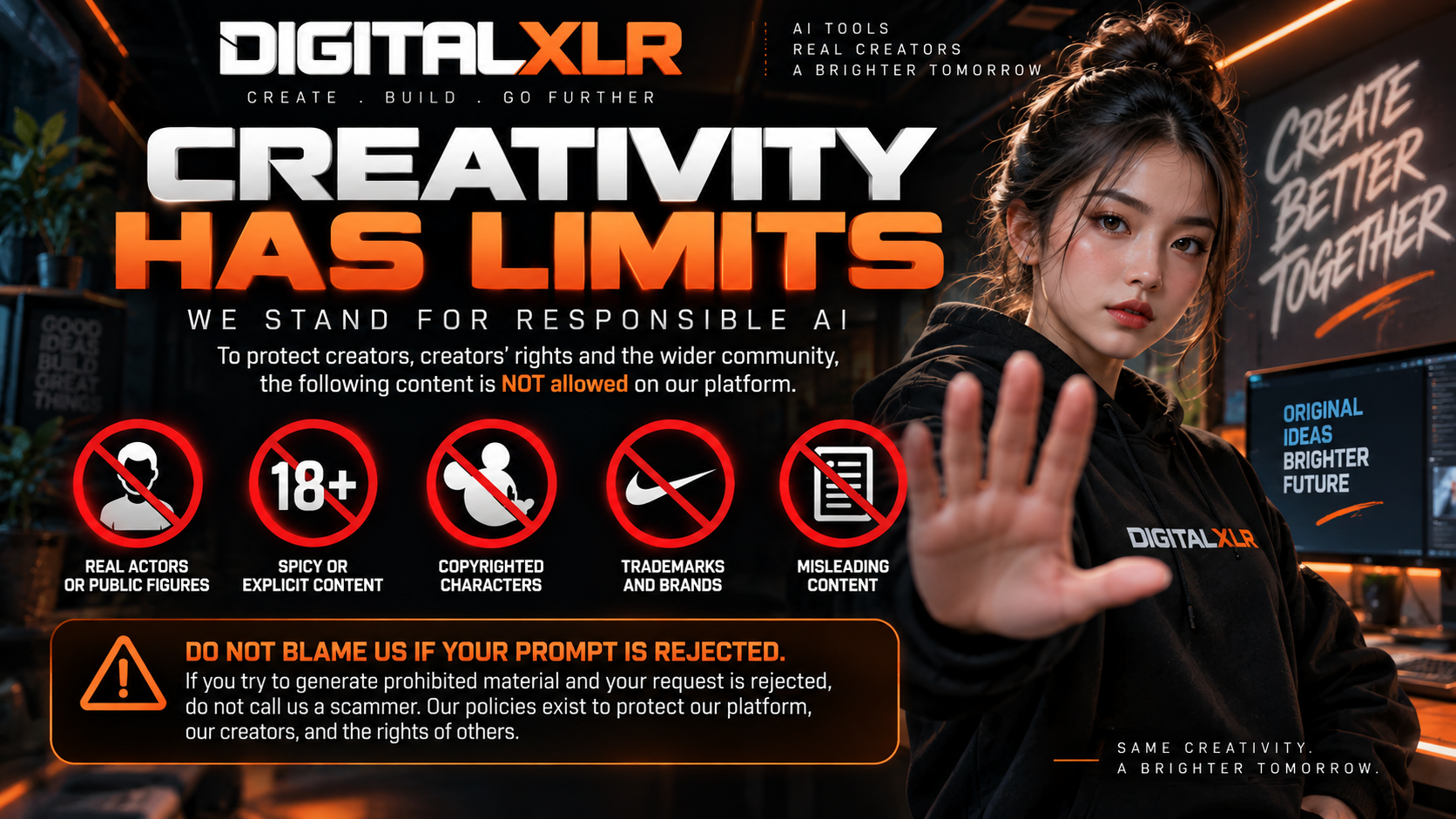
DIGITALXLR takes a firm position against using our platform to create material that crosses important boundaries involving real people, explicit content, copyright, trademarks, brands, and other protected material. Our goal is not to prevent people from being creative. Our goal is to make sure that creativity on our platform does not become an excuse to disregard the rights of others.
One area we take seriously is the unauthorized use of real actors, celebrities, public figures, and other real individuals. A person's face, likeness, identity, and reputation are not simply assets that anyone can reproduce and use however they want. If a generation request attempts to recreate or impersonate a real person without appropriate authorization or rights, DIGITALXLR may reject the request.
We also do not position DIGITALXLR as a platform for sexually explicit or pornographic generation. Requests involving highly sexualized, explicit, or otherwise inappropriate material may be rejected by our systems. We understand that different creators have different interests and audiences, but there are boundaries that our platform chooses to maintain.
Copyright is another important part of our policy. Users should not assume that because AI can technically generate something resembling a copyrighted character or creative work, they automatically have the right to use it. Protected characters, artwork, movies, games, animation, comics, and other intellectual property can belong to their respective creators or rights holders. DIGITALXLR does not want to become a tool for bypassing those rights.
The same principle applies to trademarks and brands. Logos, trademarks, recognizable brand identities, products, and other protected commercial assets can carry legal rights and restrictions. Using them in a generation may create the impression of endorsement, affiliation, ownership, or authorization when none exists. Depending on the request and context, DIGITALXLR may therefore restrict or reject such generations.
We believe there is a better approach to AI creativity: create something original.
Instead of asking AI to reproduce somebody else's character, create your own character. Instead of copying an established brand identity, develop your own visual identity. Instead of recreating a real actor, build an original fictional personality. Instead of trying to reproduce someone else's creative work, use AI as a starting point for something genuinely new.
This is the kind of creativity we want to encourage.
We also want to address something that has become increasingly important as AI platforms introduce stronger content controls: a rejected prompt does not automatically mean that the platform is broken, fraudulent, or a scam.
If you attempt to generate prohibited material and your request is rejected, please do not blame DIGITALXLR or call us a scam because your prompt was rejected.
Our systems may refuse a request because it conflicts with our content policies, copyright and trademark considerations, likeness restrictions, explicit-content restrictions, or other platform requirements. These restrictions are intentional. They exist because we have chosen to operate DIGITALXLR with boundaries rather than simply approving every request regardless of its potential consequences.
We understand that rejection can sometimes be frustrating. A creator may have an idea in mind and expect the system to generate it exactly as requested. But having an idea does not automatically mean that every platform is obligated to generate it.
DIGITALXLR has the right to establish its own content standards, and we will continue enforcing those standards as our platform evolves.
We would rather reject a generation than knowingly facilitate material that creates unnecessary legal, rights-related, or safety problems for our company, our users, or other creators.
AI should empower creativity, not eliminate responsibility.
Our vision is to give creators powerful tools to build original characters, original stories, original businesses, original visual identities, and completely new ideas. We want people to use AI to create things that they can proudly call their own.
Creativity does not mean “anything goes.”
It means having the freedom to create while understanding where the boundaries are.
DIGITALXLR will continue improving our systems and policies as AI technology develops. Some requests will be accepted. Some requests will be restricted. Some requests will be rejected entirely.
That does not mean we are against creativity.
It means we believe responsible creativity is better creativity.
Create original.
Respect people's rights.
Respect intellectual property.
Respect trademarks and brands.
And if your prompt is rejected, understand that a restriction is a boundary — not a scam.
DIGITALXLR — Build. Create. Launch.
Frequently Asked Questions (FAQ)
Q: Why does DIGITALXLR reject requests to generate images of real people or celebrities?
DIGITALXLR rejects unauthorized generation of real individuals—including actors, celebrities, and public figures—because a person's face, likeness, identity, and reputation are protected rights that cannot be reproduced without proper authorization.
Q: Can I use DIGITALXLR to create content featuring copyrighted characters or brands?
No. DIGITALXLR restricts generations involving copyrighted characters, artwork, movies, games, comics, logos, trademarks, and brand identities to avoid facilitating intellectual property infringement and unauthorized commercial use.
Q: Is DIGITALXLR broken or a scam if it rejects my prompt?
No. Rejected prompts indicate DIGITALXLR's content policies are functioning as designed. The platform intentionally enforces boundaries around explicit content, likeness rights, and intellectual property rather than approving all requests regardless of consequences.
Q: What kind of AI-generated content does DIGITALXLR encourage?
DIGITALXLR encourages original creativity—creating unique characters, developing distinctive visual identities, building fictional personalities, and using AI as a starting point for genuinely new creative works rather than reproducing existing protected material.